Editor's note
Amalfi Coast from Miami
An editor's pick for the Mediterranean week that rewards patience, a single base, and the decision to visit in the shoulder season rather than the high.
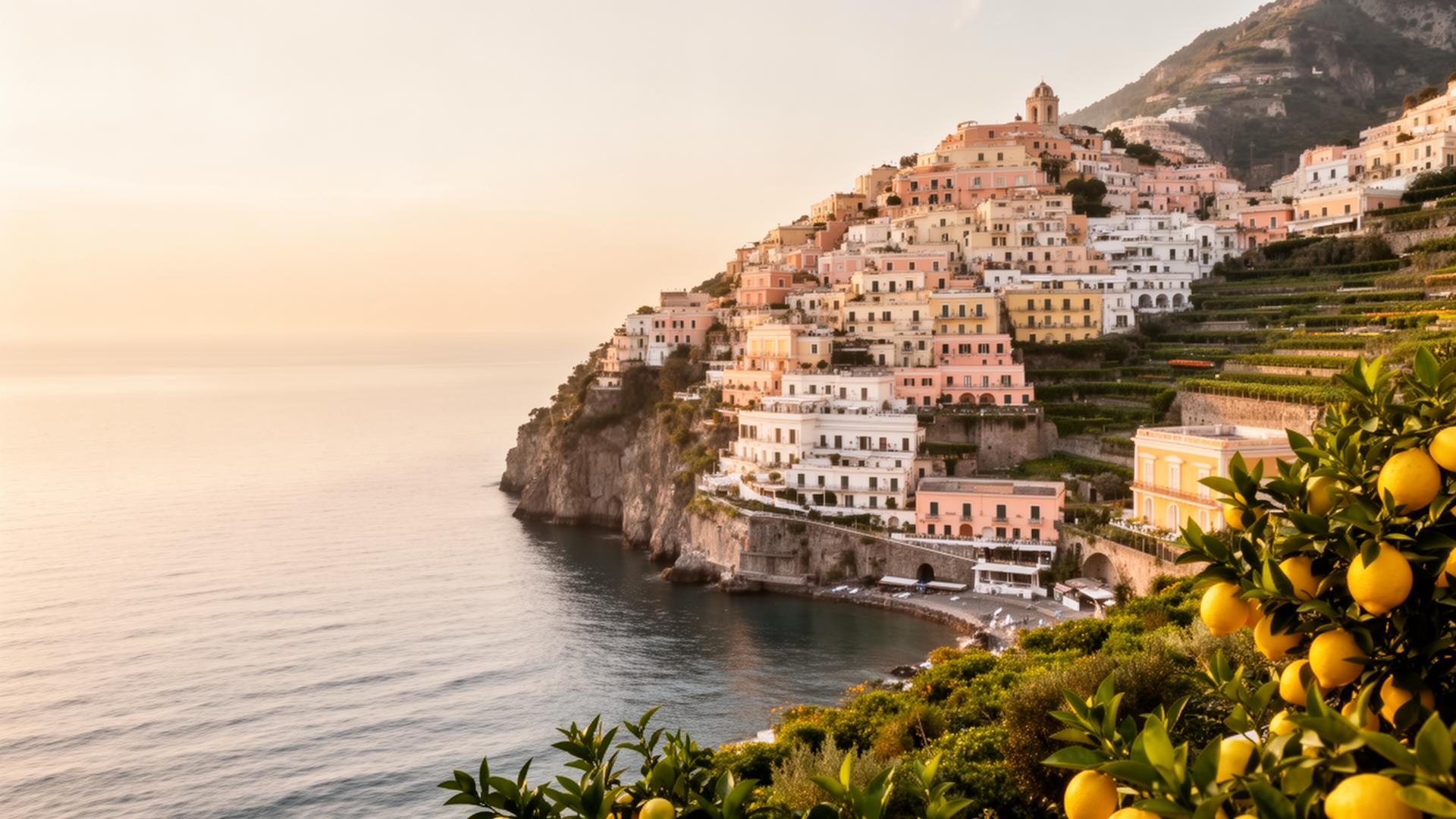
The Amalfi Coast is a narrow strip of cliff, garden, and sea that runs between Positano and Vietri sul Mare, and its reputation for beauty is, on this occasion, entirely accurate. The villages are stacked vertically rather than spread horizontally, which means the experience is more intimate than its fame suggests, and the best version of the trip is built around a single base rather than a succession of moves. Four to six nights is the right duration; long enough to find a table you return to, short enough to leave before the roads begin to feel like the point.
Flight Time
9-12h via FCO or NAP
Best For
Couples · milestone trips · slow travel
Best Season
June and September
Some links are affiliate links. We may earn a small commission, at no extra cost to you. Full disclosure.
Overview
The Amalfi Coast is a narrow strip of cliff, garden, and sea that runs between Positano and Vietri sul Mare, and its reputation for beauty is, on this occasion, entirely accurate. The villages are stacked vertically rather than spread horizontally, which means the experience is more intimate than its fame suggests, and the best version of the trip is built around a single base rather than a succession of moves. Four to six nights is the right duration; long enough to find a table you return to, short enough to leave before the roads begin to feel like the point.
Why It Works from Miami
From Miami, the cleanest routing connects through Rome (FCO) or Naples (NAP) on a single connection, with total journey times of nine to twelve hours depending on the airline and layover. Naples is the more direct arrival for the coast itself, a transfer of roughly ninety minutes by private car to Positano or Ravello, and the drive along the SS163 is the first indication that the trip is going to deliver on what it promised. Flying into FCO adds a city night in Rome as a natural first act, which is not a hardship.
Where to Stay
Choose a base rather than a series of hotels. Positano for the most photographed version of the coast, sociable and well-served; Ravello for altitude, gardens, and genuine quiet; Praiano for the least crowded stretch of the drive with direct sea access. Avoid July and August if the brief is restful rather than festive; the coast handles volume less gracefully than its photographs suggest.
Editor's Picks · Hotels
03 houses
Three properties we return to when readers ask where to stay along the coast.
- 01of 03
A house we trust
Le Sirenuse, Positano
The benchmark address on the Amalfi Coast, a family-owned palazzo above Positano with sixty rooms, a sea-water pool cut into the terrace, and a considered restraint that the most famous hotels on this coastline sometimes forget. The views from the upper rooms are among the most quietly affecting in the Mediterranean, and the service operates at the precise pitch between attentive and invisible.
Check rates on Klook - 02of 03
A house we trust
Belmond Hotel Caruso, Ravello
An eleventh-century palazzo on a clifftop above Ravello, restored by Belmond with an infinity pool that faces the full length of the Gulf of Salerno. The altitude separates it from the coast road entirely, which makes it the quietest address on this list and the one most suited to travelers whose brief is genuine stillness rather than proximity to the village.
Check rates on Klook - 03of 03
A house we trust
Casa Angelina, Praiano
A quietly modernist clifftop hotel above Praiano, white-walled and spare in a way that reads as a deliberate counterpoint to the baroque abundance of its neighbours. Forty rooms, a sea-level pool accessible by lift, and a stretch of coast that sees a fraction of Positano's traffic. The most considered choice for travelers who want the Amalfi light without the Amalfi crowd.
Check rates on Klook
How to Get There
A note on flights
From Miami, American Airlines and connecting carriers route cleanly through Rome (FCO) or, with slightly fewer options, Naples (NAP) direct. The Naples arrival is the more efficient choice for the coast, cutting the transfer to a single ninety-minute drive. Rome adds a natural city prologue and tends to offer more schedule flexibility on the outbound leg. If you would like to compare fares and connections in one place, you can search flights from Miami and build the routing that feels least rushed.
Explore flights from MiamiOn Arrival · Private Transfers
The drive from Naples Airport to Positano takes roughly ninety minutes under normal conditions and considerably longer in summer traffic, which makes a pre-booked private car the only sensible arrangement. The SS163 coast road is narrow, dramatic, and not well-suited to navigating unfamiliar, and arriving with a driver who knows it removes the one element of the journey that would otherwise compete with the scenery.
The arrangement we use
A pre-booked private car, waiting at arrivals.
The single concierge step that turns a long travel day into a quiet one. We default to it on every trip we plan from Miami.
Book a private transfer with KiwitaxiAlso worth considering
What to Pack
The Amalfi Coast is warm, steep, and occasionally formal at dinner. Linen is the right fabric in both registers: light enough for the heat, considered enough for a good table. Flat shoes earn their place over everything with a heel; the steps between villages are not a detail, they are a significant portion of the day. A compact crossbody bag handles the narrow lanes better than a shoulder tote, and a light layer for evenings in Ravello, where the altitude drops the temperature noticeably after dark, is the one thing most first-time visitors leave behind.
For a broader view of what earns its place in the carry-on, start with our Travel Essentials guide.
A short packing edit
- 01
Hard-side carry-on suitcase
A compact hard-side carry-on that handles the FCO or NAP connection and fits the overhead on most transatlantic carriers, keeping four to six nights of considered resort wear in order without requiring checked luggage.
View on Amazon - 02
Packing cubes
Neutral packing cubes that separate linen layers, evening wear, and travel-day clothes so that unpacking into a clifftop hotel room takes under three minutes.
View on Amazon - 03
Flat leather sandals
A pair of well-made flat leather sandals that cover every context from village steps to a good dinner without drawing attention to themselves, the single most useful footwear decision on this trip.
View on Amazon - 04
Linen resort wear
Two or three linen pieces in a restrained palette that move from morning terraces to afternoon beaches to evening tables without requiring a full change, the Amalfi dress code at its most functional.
View on Amazon - 05
Compact crossbody bag
A structured crossbody that keeps hands free on narrow lanes and stone staircases, with enough room for a phone, sunscreen, and a light layer folded flat.
View on Amazon - 06
Portable charger
A slim power bank that keeps a phone running across a full day of navigating, photographing, and the occasional long lunch with no power point in sight.
View on Amazon
Stay Connected
Connectivity
Land in Naples already online.
Italy runs on European networks, and most US carriers offer international roaming at a daily rate that adds up quickly over a week. An eSIM activated before departure keeps maps, restaurant reservations, and ferry schedules running from the moment you land at NAP, without the cost of a full roaming plan or the delay of finding a SIM card in the arrivals hall.
Set up an Italy eSIMBefore You Go
US passport holders enter Italy without a visa for stays under ninety days. The local currency is the euro. Summer on the Amalfi Coast runs hot, crowded, and expensive from mid-July through August; June and September are the considered traveler's months, with full warmth, lower volume, and the same light. Driving the SS163 independently is possible but not necessary; water taxis and ferries between the main villages are the quieter and often faster alternative.
The Amalfi Coast rewards careful planning, and the gap between a well-arranged trip and an improvised one is wider here than almost anywhere else in the Mediterranean. Comprehensive travel coverage protects the investment against weather delays, missed connections through FCO or NAP, or the unexpected changes that a long-haul trip occasionally produces.
Travel coverage
Comprehensive cover, plain-language terms, and quick claims when something does go sideways.
Consider travel coverage with EKTAOn a routing through FCO or NAP, services like AirHelp can sometimes pursue compensation on your behalf when a flight is significantly delayed or cancelled.
For your time in Amalfi Coast
More from The Mediterranean
Related Reads